Kubernetes Orchestration: A Practical Guide to Managing Modern Containerized Applications

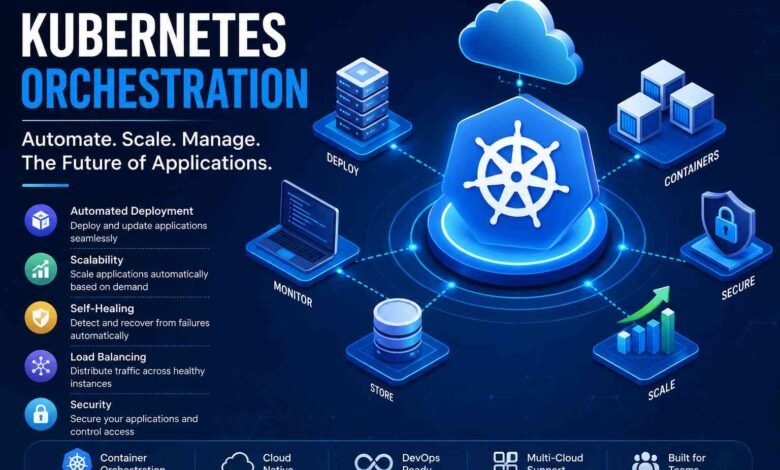
Modern software applications are becoming increasingly complex. Organizations now rely on dozens or even hundreds of microservices working together to deliver a seamless user experience. Managing these services manually can quickly become difficult, especially when applications need to scale, recover from failures, and remain available around the clock.
This is where kubernetes orchestration plays an essential role. It provides an automated way to deploy, manage, scale, and monitor containerized applications across different environments. By reducing manual intervention and improving operational efficiency, Kubernetes has become a core technology for businesses adopting cloud-native architectures.
Table of Contents
ToggleUnderstanding the Concept of Container Orchestration
Before exploring Kubernetes itself, it is important to understand container orchestration. Containers package applications and their dependencies into lightweight, portable units. While running a few containers is straightforward, managing hundreds of them across multiple servers creates operational challenges.
Container orchestration automates tasks such as deployment, networking, load balancing, health monitoring, scaling, and recovery. Instead of administrators manually handling these responsibilities, orchestration platforms perform them automatically based on predefined rules and configurations.
What Is Kubernetes?
Kubernetes is an open-source platform originally developed by Google and later donated to the Cloud Native Computing Foundation (CNCF). It helps organizations manage containerized workloads efficiently and consistently.
The platform organizes containers into logical groups called pods and distributes them across a cluster of machines. Kubernetes continuously monitors the desired state of applications and takes corrective actions whenever discrepancies occur. This self-healing capability makes it highly reliable for production environments.
Why Kubernetes Has Become an Industry Standard
Businesses across industries have embraced Kubernetes because it addresses common infrastructure challenges. Traditional deployment methods often require significant manual effort, making scaling and maintenance time-consuming.
Kubernetes simplifies these processes by providing automation, portability, and consistency. Applications can run in public clouds, private data centers, or hybrid environments without requiring major architectural changes. This flexibility allows organizations to avoid vendor lock-in while maintaining operational efficiency.
Core Components of a Kubernetes Cluster
A Kubernetes cluster consists of several components working together to manage workloads effectively.
The control plane acts as the brain of the cluster. It makes scheduling decisions, manages resources, and ensures the cluster operates according to defined configurations. Worker nodes are responsible for running application containers and executing workloads.
Additional components include the API server, scheduler, controller manager, and etcd database. Together, these services maintain cluster stability and ensure applications remain available even during failures.
How Kubernetes Orchestration Works
The primary goal of kubernetes orchestration is to maintain the desired state of applications automatically. Administrators define how applications should run, including the number of replicas, networking requirements, and resource limits.
Kubernetes constantly compares the actual state of the cluster with the desired state. If a container crashes, the platform automatically replaces it. If traffic increases, additional instances can be created. If a server becomes unavailable, workloads are redistributed to healthy nodes.
This continuous monitoring and adjustment process reduces downtime and improves application reliability.
Automated Deployment and Rollouts
Application deployment is one of the most valuable features of Kubernetes. Instead of manually updating servers, teams can define deployment configurations using YAML files.
When a new version of an application is released, Kubernetes performs rolling updates. New containers are gradually introduced while older versions are removed. This approach minimizes disruption and allows users to continue accessing services during updates.
If problems occur, administrators can quickly roll back to a previous version, reducing the impact of deployment failures.
Scaling Applications Efficiently
Traffic demands can fluctuate significantly throughout the day. Applications may experience sudden spikes due to marketing campaigns, seasonal events, or viral content.
Kubernetes addresses this challenge through automatic scaling. Based on CPU utilization, memory usage, or custom metrics, the platform can increase or decrease the number of running instances. This ensures applications maintain performance during high demand while avoiding unnecessary resource consumption during quieter periods.
As a result, organizations can optimize infrastructure costs while maintaining a positive user experience.
Self-Healing Capabilities
Reliability is a critical requirement for modern applications. Unexpected failures can lead to lost revenue, reduced productivity, and customer dissatisfaction.
One of the strongest advantages of kubernetes orchestration is its self-healing functionality. Kubernetes continuously monitors containers and services. When issues are detected, it automatically restarts failed containers, replaces unhealthy instances, and reschedules workloads when necessary.
This automated recovery process helps maintain high availability without requiring constant human intervention.
Service Discovery and Load Balancing
Applications often consist of multiple services communicating with one another. Managing these connections manually can become difficult as environments grow.
Kubernetes simplifies networking through built-in service discovery. Each service receives a stable endpoint, allowing components to communicate reliably regardless of where containers are running.
The platform also distributes incoming traffic across available instances using load balancing techniques. This ensures workloads are evenly distributed and prevents individual containers from becoming overloaded.
Resource Management and Optimization
Efficient resource allocation is essential for controlling infrastructure costs. Kubernetes allows administrators to define CPU and memory requests as well as usage limits for containers.
By intelligently scheduling workloads, Kubernetes maximizes resource utilization across the cluster. Applications receive the resources they need while preventing individual services from consuming excessive capacity.
This balance helps organizations improve performance while maintaining predictable operational expenses.
Security Benefits of Kubernetes
Security remains a top priority for organizations deploying containerized applications. Kubernetes provides multiple features designed to strengthen security and protect workloads.
Administrators can implement role-based access control (RBAC), network policies, secrets management, and workload isolation. These capabilities help ensure that only authorized users and services can access sensitive resources.
Regular updates from the Kubernetes community also contribute to a strong security posture by addressing vulnerabilities and introducing new protective features.
Monitoring and Observability
Visibility into application performance is critical for maintaining reliable services. Kubernetes integrates with a wide range of monitoring and observability tools.
Metrics platforms such as Prometheus collect performance data, while visualization tools like Grafana present insights through dashboards. Logging systems help teams troubleshoot issues quickly and identify performance bottlenecks before they affect users.
Comprehensive monitoring allows organizations to make informed decisions and continuously improve application performance.
Kubernetes in Multi-Cloud and Hybrid Environments
Many organizations operate across multiple cloud providers or maintain a combination of cloud and on-premises infrastructure.
Kubernetes orchestration provides a consistent platform for managing workloads across these environments. Developers can deploy applications using the same configurations regardless of where the underlying infrastructure resides.
This portability simplifies migration projects, improves flexibility, and supports long-term infrastructure strategies.
Common Use Cases for Kubernetes
Kubernetes supports a wide range of application scenarios. It is frequently used for microservices architectures, web applications, APIs, data processing platforms, machine learning workloads, and enterprise software systems.
Organizations also leverage Kubernetes for continuous integration and continuous deployment (CI/CD) pipelines. Automated deployment workflows help development teams release updates more frequently while maintaining quality and reliability.
Its versatility makes it suitable for businesses of all sizes, from startups to large enterprises.
Best Practices for Successful Kubernetes Adoption
Implementing Kubernetes successfully requires careful planning and ongoing management. Organizations should establish clear resource policies, automate deployments, monitor performance, and regularly update clusters.
Security should be integrated from the beginning rather than treated as an afterthought. Teams should also invest in training to ensure administrators and developers understand Kubernetes concepts and operational requirements.
Following these best practices helps maximize the benefits of the platform while reducing operational complexity.
The Future of Kubernetes
The Kubernetes ecosystem continues to evolve rapidly. New tools, extensions, and cloud-native technologies are expanding its capabilities and simplifying management.
As organizations continue adopting containers and microservices, kubernetes orchestration will remain a foundational technology for modern infrastructure. Its flexibility, automation, and scalability make it well-positioned to support future application development trends.
Businesses that invest in Kubernetes today are likely to benefit from a mature ecosystem and strong community support for years to come.
Conclusion
Kubernetes has transformed the way organizations deploy and manage containerized applications. Through automation, scalability, self-healing, and portability, it enables teams to operate complex systems with greater efficiency and reliability.
The growing adoption of kubernetes orchestration reflects its ability to solve real-world infrastructure challenges. Whether supporting small applications or large enterprise platforms, Kubernetes provides the tools needed to maintain performance, reduce operational overhead, and deliver consistent user experiences in modern cloud-native environments.
FAQs
1. What is Kubernetes used for?
Kubernetes is used to deploy, manage, scale, and automate containerized applications.
2. Is Kubernetes free to use?
Yes, Kubernetes is an open-source platform and can be used without licensing fees.
3. Why is Kubernetes important?
It automates infrastructure management, improves scalability, and increases application reliability.
4. Can Kubernetes run on any cloud provider?
Yes, Kubernetes works across public clouds, private clouds, and hybrid environments.
5. Does Kubernetes support automatic scaling?
Yes, Kubernetes can automatically scale applications based on resource usage and demand.
More Details : MacBook M3: Features, Performance, Battery Life, and Everything You Need to Know