My Son Can’t See. How Do I Explain Colours to Him?

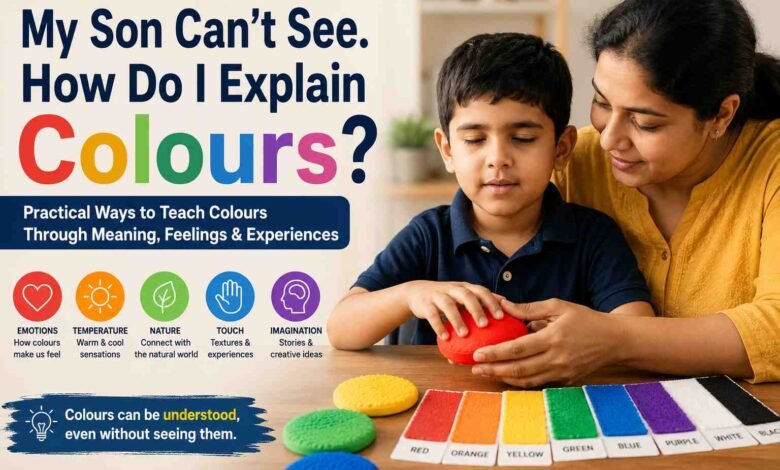
When a child is blind or has very limited vision, many parents face a question that feels surprisingly difficult: my son can’t see. how do i explain colours to him? Since colours are usually taught through sight, it can seem impossible to describe something that cannot be directly experienced visually.
The good news is that colours can still be explained in meaningful ways. A child does not need to see colours to understand what they represent, how people use them, and the feelings, sensations, and associations connected to them. The goal is not to recreate vision but to build a rich understanding of the world through the senses and experiences your child already has.
This article explores practical and compassionate ways to explain colours to a blind child while helping them develop confidence and curiosity about the world around them.
Table of Contents
ToggleUnderstanding What Colour Really Is
Before explaining colours to your child, it helps to understand what colour actually is. Scientifically, colours are different wavelengths of light that the eyes and brain interpret. For someone who cannot see, that visual experience is unavailable.
However, colour is more than a scientific phenomenon. In everyday life, colours are connected to emotions, temperatures, textures, sounds, memories, and cultural meanings. This broader understanding creates opportunities for meaningful explanations.
Rather than trying to make your child “see” colour through words, focus on helping them understand what colours mean to people and how they are used in daily life.
Accept That Colours May Be Abstract
One of the most important things parents can do is accept that colours may remain somewhat abstract. This is perfectly normal.
Sighted children often learn colours by repeatedly seeing them attached to objects. A blind child learns differently. Colours may become concepts rather than direct sensory experiences.
For example, a child can understand what music is without being able to play every instrument. Similarly, a blind child can understand colours without visually experiencing them.
Removing the pressure to perfectly define colours often makes conversations more relaxed and effective.
Use Real-Life Sensory Associations
The best way to explain colours is by connecting them to experiences your child already understands.
Sensory associations help transform an abstract idea into something relatable. While no comparison is exact, these associations can provide a useful framework.
For example:
- Red can be associated with warmth from the sun on your skin.
- Blue may be linked to cool water or a gentle breeze.
- Yellow can be compared to the feeling of sunshine on a pleasant day.
- Green may be connected to soft grass, leaves, and nature.
- Orange can be associated with warmth and energy.
- Purple might be described as calm, rich, and imaginative.
- White can represent cleanliness, freshness, or a smooth surface.
- Black may represent darkness, quietness, or stillness.
These descriptions give children reference points based on experiences they can directly access.
Explain Colours Through Emotions
Emotions offer another helpful way to discuss colours.
Many cultures associate certain colours with specific feelings. Although these associations vary, they can help children understand how colours are commonly perceived.
For instance:
Red and Excitement
Red is often linked with excitement, energy, love, and strong emotions. You might compare it to the feeling of being thrilled about a birthday or celebrating a special occasion.
Blue and Calmness
Blue is frequently associated with calmness and peace. It can be compared to relaxing while listening to gentle rain or sitting quietly in a comfortable place.
Yellow and Happiness
Yellow often represents joy, optimism, and friendliness. Think about the feeling of laughing with friends or enjoying a fun day outdoors.
Green and Balance
Green is commonly connected to growth, nature, and balance. It can represent peaceful walks, gardens, and fresh air.
By linking colours to emotions, children can develop meaningful interpretations that fit naturally into their understanding of the world.
Use Temperature Comparisons
Temperature-based descriptions can be particularly effective because they are easy to experience physically.
Warm Colours
Colours such as red, orange, and yellow are often called warm colours. They can be described using experiences like:
- Sitting near a fireplace
- Holding a warm cup of cocoa
- Feeling sunshine on your face
Cool Colours
Blue, green, and some shades of purple are often considered cool colours. These can be linked to:
- Cool water
- A refreshing breeze
- Shade on a hot day
This approach helps children understand why people group certain colours together.
Connect Colours to Familiar Objects
Another practical method is associating colours with objects your child encounters regularly.
For example:
- Bananas are usually yellow.
- Grass is generally green.
- The sky is often described as blue.
- Strawberries are commonly red.
- Snow is white.
- Coal is black.
When introducing these examples, explain that colour is one characteristic among many. This helps your child understand how sighted people identify and describe objects.
Over time, these associations build a mental framework for understanding colour references in conversation.
Describe How Society Uses Colours
Colours play a major role in communication and design. Teaching your child about these uses can help them navigate the world more confidently.
People use colours to:
- Identify traffic signals
- Organize information
- Represent sports teams
- Express personal style
- Decorate homes
- Communicate warnings
For example, traffic lights use red for stop and green for go. Explaining these practical applications helps children understand why colours matter in everyday life.
Introduce Colour Symbolism
Many colours carry symbolic meanings.
While these meanings vary between cultures, understanding common associations can help children interpret stories, conversations, and media.
Examples include:
- Red often symbolizes passion or courage.
- Blue may symbolize trust or stability.
- Green can represent growth or renewal.
- White is often associated with purity or peace.
- Black may symbolize formality, mystery, or elegance.
These symbolic meanings add another layer to a child’s understanding of colours.
Encourage Questions and Exploration
Children naturally ask questions about concepts they do not fully understand. Encourage these conversations rather than avoiding them.
Your child may ask:
- What is your favorite colour?
- Why do people like certain colours?
- Why do colours have names?
- How do colours affect clothing choices?
These discussions can become valuable learning opportunities. Answer honestly and admit when something is difficult to explain. Curiosity often matters more than perfect explanations.
Use Stories and Imagination
Storytelling can make colours more meaningful.
You might describe red as the energetic hero of a story, blue as a calm and thoughtful character, or yellow as a cheerful friend who brightens everyone’s day.
These imaginative descriptions help transform colours from abstract terms into memorable concepts.
Many blind children develop strong imaginative abilities, making stories an effective teaching tool.
Understand That Every Child Learns Differently
There is no single correct way to explain colours.
Some children enjoy emotional descriptions. Others prefer scientific explanations. Some learn best through sensory comparisons, while others connect more with practical examples.
Pay attention to what interests your child and adapt your explanations accordingly.
The goal is not to force understanding but to provide tools that help your child build their own meaningful interpretation of colours.
Focus on Inclusion Rather Than Limitation
When parents ask, my son can’t see. how do i explain colours to him?, the concern often comes from a desire to help their child participate fully in the world.
Remember that blind children are capable of understanding complex concepts. Colours may be experienced differently, but they are not beyond comprehension.
By discussing colours openly, you help your child engage in conversations, understand cultural references, and participate confidently in social situations.
The emphasis should always be on expanding understanding rather than highlighting what is missing.
Conclusion
If you have ever wondered, my son can’t see. how do i explain colours to him?, the answer lies in connecting colours to experiences your child already knows and understands. Colours can be explained through emotions, temperatures, objects, stories, symbols, and everyday situations.
A blind child does not need visual perception to develop a meaningful understanding of colour. Through patient conversations and real-world examples, colours can become rich concepts that help your child connect with the world around them.
The most important thing is not finding the perfect definition of a colour. It is creating opportunities for learning, imagination, and confidence. With time, your child can develop a personal understanding of colours that is every bit as meaningful as anyone else’s.
FAQs
1. Can a blind child truly understand colours?
Yes. While they may not experience colours visually, they can understand their meanings, associations, symbolism, and everyday uses.
2. What is the easiest way to explain colours to a blind child?
Using sensory experiences such as temperature, touch, sounds, emotions, and familiar objects is often the most effective approach.
3. Should I teach colour names even if my child cannot see?
Absolutely. Colour names are commonly used in daily conversation, education, and social interactions, making them important concepts to learn.
4. Are colour-emotion associations scientifically accurate?
Not always. They are cultural and personal associations, but they can help children build a practical understanding of colours.
5. Is there a right or wrong way to explain colours?
No. Every child learns differently. The best method is the one that helps your child connect colours with experiences they already understand.
More Details : Canon C50 Review: Is This Compact Cinema Camera Worth It?