Docker Interview Questions: A Complete Guide for Job Seekers

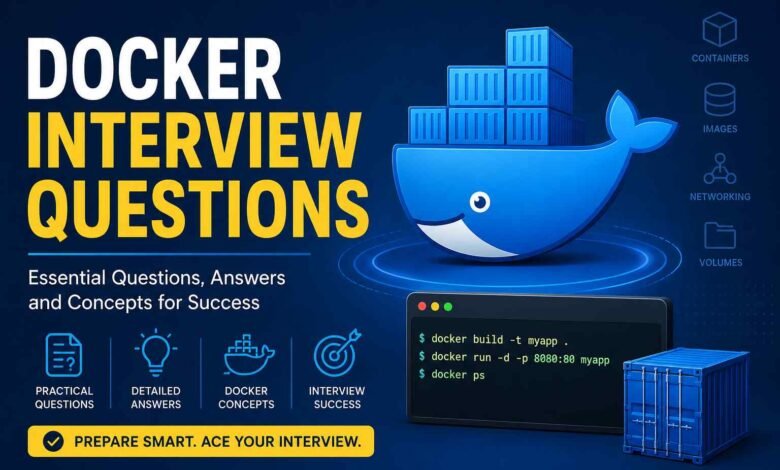
Preparing for a technical interview can feel challenging, especially when containerization technologies are involved. Docker has become one of the most widely used tools in modern software development, DevOps, cloud computing, and application deployment. As organizations continue to adopt container-based infrastructure, employers increasingly evaluate candidates on their Docker knowledge during technical interviews.
Understanding common docker interview questions can help candidates demonstrate both theoretical knowledge and practical experience. Whether you are a beginner, a DevOps engineer, a software developer, or a system administrator, knowing the concepts behind Docker can significantly improve your interview performance.
This guide covers essential Docker concepts and the questions recruiters frequently ask, along with detailed explanations that can help you build confidence before your next interview.
Table of Contents
ToggleWhat Is Docker?
One of the most common interview questions starts with the basics.
Docker is an open-source platform that enables developers to package applications and their dependencies into lightweight, portable containers. These containers can run consistently across different environments, including development machines, testing servers, and production systems.
Unlike traditional virtual machines, Docker containers share the host operating system kernel, making them faster and more resource-efficient.
Interviewers often ask this question to assess whether candidates understand the core purpose of Docker and why it has become a critical technology in modern software development.
Explain the Difference Between Docker and Virtual Machines
This is among the most frequently asked docker interview questions because it tests foundational understanding.
Virtual machines include a complete guest operating system and require a hypervisor to run. As a result, they consume more memory and storage resources.
Docker containers, on the other hand, share the host operating system kernel and package only the application along with its required libraries and dependencies.
Key differences include:
- Containers start in seconds.
- Containers use fewer resources.
- Virtual machines provide stronger isolation.
- Docker supports higher application density on the same hardware.
Understanding these distinctions demonstrates your knowledge of containerization architecture.
What Is a Docker Image?
A Docker image is a read-only template used to create containers.
Images contain everything needed to run an application, including:
- Application code
- Runtime environment
- System tools
- Libraries
- Configuration files
When a container is launched, Docker creates a writable layer on top of the image.
Interviewers often expect candidates to explain that images act as blueprints while containers are running instances of those images.
What Is a Docker Container?
A container is a lightweight, executable package that contains an application and all of its dependencies.
Containers ensure consistency across different environments because the application behaves the same regardless of where it is deployed.
Benefits of containers include:
- Fast deployment
- Portability
- Scalability
- Resource efficiency
- Environment consistency
Being able to clearly explain containers is essential when answering docker interview questions during technical evaluations.
What Is a Dockerfile?
A Dockerfile is a text document that contains instructions used to build a Docker image automatically.
Common Dockerfile instructions include:
FROM
Defines the base image.
Example:
FROM ubuntu:22.04RUN
Executes commands during image creation.
COPY
Copies files from the host machine into the image.
CMD
Specifies the default command executed when the container starts.
Interviewers frequently ask about Dockerfiles because they are fundamental to container image creation.
What Is Docker Hub?
Docker Hub is a cloud-based repository that stores Docker images.
It serves as a central location where developers can:
- Upload images
- Share images
- Download official images
- Manage private repositories
Popular official images available on Docker Hub include:
- Nginx
- MySQL
- Redis
- Ubuntu
- Node.js
Many organizations rely on Docker Hub to streamline application deployment workflows.
Explain the Difference Between CMD and ENTRYPOINT
This topic appears regularly in technical interviews.
CMD
CMD provides default arguments that can be overridden when running a container.
ENTRYPOINT
ENTRYPOINT defines the primary executable for the container.
When both are used together:
- ENTRYPOINT specifies the executable.
- CMD provides default parameters.
Understanding this distinction demonstrates deeper Docker knowledge and practical experience.
What Is Docker Compose?
Docker Compose is a tool used to define and manage multi-container applications.
Instead of running multiple Docker commands manually, developers can describe services in a YAML file.
A typical Compose configuration may include:
- Web server
- Database
- Cache service
- Message queue
Benefits include:
- Simplified deployment
- Consistent environments
- Easy service management
- Faster development workflows
Knowledge of Docker Compose is commonly tested during interviews for DevOps and backend development roles.
What Is Docker Networking?
Docker networking enables communication between containers and external systems.
Docker provides several network types:
Bridge Network
Default network mode used for communication between containers on the same host.
Host Network
Allows containers to use the host machine’s network stack directly.
Overlay Network
Supports communication across multiple Docker hosts.
None Network
Disables networking entirely.
Interviewers often evaluate whether candidates understand container communication and network isolation.
What Are Docker Volumes?
Docker volumes provide persistent storage for containers.
Normally, data stored inside a container is lost when the container is removed.
Volumes solve this issue by storing data outside the container lifecycle.
Advantages include:
- Data persistence
- Easier backups
- Improved performance
- Data sharing between containers
Database containers commonly rely on volumes to preserve important information.
What Is the Difference Between COPY and ADD?
This question appears frequently among intermediate-level Docker interviews.
COPY
Transfers files and directories from the host machine into the image.
ADD
Performs the same function as COPY but includes additional capabilities such as:
- Extracting compressed files
- Downloading files from URLs
Because COPY is simpler and more predictable, it is generally recommended unless ADD’s extra functionality is required.
How Do You Optimize Docker Images?
Organizations value engineers who can build efficient containers.
Common optimization techniques include:
Use Smaller Base Images
Alpine Linux images are often significantly smaller than standard distributions.
Combine Commands
Reducing image layers helps decrease image size.
Remove Temporary Files
Delete unnecessary files after installation.
Use Multi-Stage Builds
Separate build environments from runtime environments.
Avoid Installing Unnecessary Packages
Only include dependencies required by the application.
These practices improve deployment speed and reduce infrastructure costs.
What Is Docker Swarm?
Docker Swarm is Docker’s native orchestration solution.
It enables users to manage clusters of Docker hosts as a single system.
Key features include:
- Load balancing
- High availability
- Service scaling
- Automated failover
- Rolling updates
Although Kubernetes dominates modern container orchestration, Docker Swarm concepts still appear in some interviews.
What Is Kubernetes and How Does It Relate to Docker?
Interviewers often connect Docker and Kubernetes topics.
Docker is responsible for container creation and execution.
Kubernetes is responsible for orchestrating and managing containers at scale.
Kubernetes handles:
- Deployment
- Scaling
- Service discovery
- Load balancing
- Self-healing
Understanding the relationship between these technologies demonstrates broader container ecosystem knowledge.
Common Troubleshooting Scenarios in Docker Interviews
Practical interview rounds frequently include troubleshooting questions.
Examples include:
Container Exits Immediately
Possible causes:
- Incorrect startup command
- Application crash
- Configuration errors
Unable to Access Application
Possible causes:
- Incorrect port mapping
- Firewall restrictions
- Network configuration issues
Image Build Failure
Possible causes:
- Missing files
- Invalid Dockerfile instructions
- Dependency issues
Employers often value troubleshooting skills as much as theoretical knowledge.
Best Practices for Docker Interviews
Preparing effectively can improve your performance significantly.
Understand Core Concepts
Master images, containers, networking, volumes, and Dockerfiles.
Practice Commands
Become familiar with commonly used Docker commands.
Build Real Projects
Hands-on experience often matters more than memorized answers.
Learn Container Security
Understand image scanning, least privilege principles, and secure configurations.
Study Deployment Workflows
Know how Docker integrates with CI/CD pipelines and cloud platforms.
Candidates who combine theoretical knowledge with practical examples usually stand out during technical interviews.
Conclusion
Docker has become an essential technology in modern software development, cloud infrastructure, and DevOps practices. Employers increasingly expect candidates to understand containerization concepts, deployment strategies, networking, storage management, and troubleshooting techniques.
Preparing for common docker interview questions helps you build confidence and demonstrate real-world expertise during technical discussions. Rather than memorizing answers, focus on understanding the underlying concepts and practicing hands-on Docker usage. A strong combination of practical experience and theoretical knowledge will greatly increase your chances of success in Docker-related interviews and technical assessments.
FAQs
1. What are the most important Docker topics for interviews?
The most important topics include Docker images, containers, Dockerfiles, networking, volumes, Docker Compose, and container orchestration concepts.
2. Is Docker necessary for DevOps interviews?
Yes. Docker is considered a core skill for many DevOps, cloud engineering, and platform engineering positions.
3. What is the difference between a Docker image and a container?
A Docker image is a blueprint, while a container is a running instance of that image.
4. Why are Docker volumes used?
Docker volumes provide persistent storage so data remains available even after containers are removed or recreated.
5. Do interviewers ask Docker command-line questions?
Yes. Many interviews include practical questions about building images, running containers, viewing logs, managing networks, and troubleshooting issues.
More Details : Kanibalismo Meaning: Understanding the History, Culture, and Context of Cannibalism